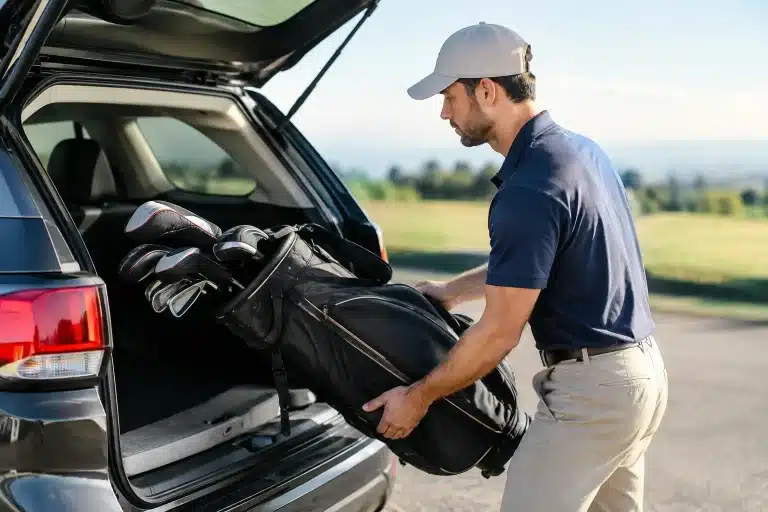
A full golf bag is awkward in ways ordinary luggage is not. It is long, unevenly weighted and expensive, and a rushed ride to the airport or course can leave clubs knocked together, squeezed against other bags or simply without enough room. Knowing how to transport golf clubs starts with matching the protection and vehicle space to your journey.
For a quick trip to a local course, a sturdy carry bag and a vehicle with a clear boot may be enough. For a flight, a family holiday or a golf day with several players, planning ahead matters far more. The aim is simple: your clubs arrive dry, protected and ready for the first tee, while everyone travelling has a comfortable seat.
Choose protection for the journey, not just the bag
Your golf bag holds your clubs, but it is not always designed to protect them in transit. A soft travel cover is usually suitable when you are placing the bag carefully in a private car, maxi cab or minibus. It keeps straps contained, protects against light rain and prevents the bag from rubbing on other luggage.
For airline travel, a padded travel cover offers better protection. Add a stiff arm or support pole inside the bag if you have one, particularly if you carry a driver with a longer shaft. This takes pressure away from the club heads when the bag is stacked upright or other luggage is placed around it.
A hard case gives the strongest protection, but it is bulkier and can be less convenient once you arrive. It makes most sense for premium club sets, frequent flyers and journeys involving several transfers. The trade-off is luggage space: a hard case may occupy much more room in a car than a flexible padded cover.
Before closing the cover, put headcovers on your woods and driver. Wrap towels or clothing around club heads to reduce movement. Remove loose items such as rangefinders, chargers, keys and valuables from side pockets. They can be damaged, lost or set off an unnecessary search at airport security.
How to transport golf clubs by car or private hire
The best way to load clubs into a vehicle depends on the bag shape, the number of passengers and the luggage already on board. Do not assume that a standard saloon boot will fit a full-size golf bag comfortably. Some bags fit only at an angle, leaving little space for suitcases, pushchairs or another player’s equipment.
If you are travelling alone or as a pair with light luggage, a larger executive vehicle may work well. For a family, a group of golfers or airport travellers carrying suitcases, a 6-seater MPV, 7-seater maxi cab or minibus gives the driver more room to load equipment safely rather than forcing it into gaps.
When loading, place the golf bag flat where possible, with the club heads away from hard edges and heavy cases. Avoid putting heavy suitcases directly on top of the heads. If the bag must stand upright, secure it so it cannot tip over when the vehicle turns or brakes. Drivers can help with careful loading, but they need to know in advance that you are bringing golf equipment.
This is particularly useful for early tee times, when you do not want to wait through taxi queues or try to manoeuvre a long bag through crowded public transport. A pre-booked private transfer lets you specify passenger numbers, golf bags and luggage before collection, so the right vehicle can be allocated from the start.
Allow for every item, not only the golf bag
A common mistake is booking transport based on passenger seats alone. Golf trips usually involve more than clubs: cabin bags, checked suitcases, umbrellas, rain gear, shoes, drinks and sometimes children’s items all compete for the same space.
Think about the full load before choosing a vehicle. A practical booking request should include the number of people travelling, the number of golf bags, the number and approximate size of suitcases, plus collection and drop-off points. If a bag is in a hard case, say so. That one detail can affect the most suitable vehicle.
For four golfers heading straight to a course, a minibus is often more comfortable than trying to fit everyone and four bags into a smaller vehicle. For two travellers arriving at Changi Airport with clubs and large holiday luggage, a spacious MPV or maxi cab can remove a lot of uncertainty. More space is not about luxury alone – it reduces the chance of equipment being stacked unsafely and makes the ride easier after a long flight.
Prepare golf clubs for an airport transfer
Airport transfers create two separate transport jobs: getting to the terminal and protecting the bag during the flight. Give yourself enough time for both. Airlines may treat golf clubs as checked sporting equipment, and weight allowances, oversize rules and charges vary by carrier and fare type.
Check your airline’s current rules before packing. Confirm whether golf equipment counts towards your standard checked-baggage allowance, whether it needs to be declared in advance and whether there is a maximum total weight. Do not rely on an old policy or another traveller’s experience, as rules can differ even between routes operated by the same airline group.
Label the outside and inside of the travel cover with your name and contact details. Photograph the contents and the condition of the bag before leaving home. It is a sensible record if the airline misplaces or damages the equipment. You may also wish to keep a photo of your club serial numbers and check whether your travel insurance covers golf equipment at its replacement value.
At the airport, use the oversize baggage counter if directed. Keep enough time in hand for this step, especially during school holidays, major events and busy evening departures. Rushing from the drop-off point to check-in is a poor start to a golf holiday.
Plan the return trip as carefully as the outward journey
The return transfer is easy to overlook. Yet after a round in humid weather or a week away, your golf bag may be damp, muddy or carrying extra items bought during the trip. Keep a small towel or waterproof liner in the travel cover to protect the vehicle interior and your other luggage.
If your return flight lands late, advance-booking a suitable vehicle gives you one less decision to make at the terminal. Share the flight number where requested, confirm the number of bags again and keep your phone available after landing. A responsive transport provider can help coordinate a practical pickup point if the airport is busy.
MyMaxiCabSGP can arrange spacious private airport and point-to-point transport for travellers with golf bags, suitcases and group luggage, with vehicle options ranging from executive cars to larger minibuses. Clear details at booking help ensure the vehicle suits the load rather than merely the passenger count.
Avoid the small mistakes that damage clubs
Most club damage happens through pressure and movement, not dramatic impacts. Do not leave the driver exposed at the top of the bag. Do not clip a travel cover shut with straps dangling where they can catch. And do not use your golf bag as a place for passports, medication, laptops or any item you cannot afford to lose during check-in.
It also pays to consider the weather. Singapore’s sudden rain can soak a bag during a short walk between the lobby and vehicle, so keep a rain hood fitted or pack a waterproof cover. After a wet round, dry the grips and club heads before storing them for longer journeys. Moisture trapped inside a cover is unpleasant and can affect leather accessories over time.
A quick booking check before you travel
Before confirming transport, make sure the collection time allows for loading, traffic and airport check-in. Recheck your passenger count, golf bags, suitcases and special requirements. If plans change, update the provider as early as possible, because a vehicle that was right for two bags may not be right for four.
Golf travel should begin with the anticipation of the round, not a struggle at the kerbside. Protect the clubs properly, book enough luggage space and let the driver know exactly what is travelling with you. Then you can step out at the course or terminal with your equipment intact and your day still on schedule.